How Often Do Staff Require Fire Training? Protecting Lives and Ensuring Compliance in the Workplace

At Crusader Fire, we understand the paramount importance of fire safety in any workplace. Fire safety training isn’t just a box to tick off; it is a life-saving necessity that can prevent catastrophic property damage and, more importantly, protect lives. In today’s fast-paced and dynamic business environments, comprehensive fire safety training is crucial. How often do staff require fire training, how often should fire drills be conducted, and what is fire training are questions that you, as a business, should be able to answer to properly ensure the protection of you, your staff, and your lives.

What is Fire Safety Training and Why is it Indispensable?

Fire safety training is not just about learning to evacuate in case of an emergency. It is a well-structured program designed to educate your team about fire risks, prevention techniques, emergency response, and legal compliance. For businesses of all sizes, investing in fire safety training ensures that every employee knows how to prevent fires and respond effectively in an emergency.

The core objective of fire safety training is to reduce the risk of fire, mitigate its consequences, and, most importantly, save lives. A robust training program equips employees with the knowledge to recognise common fire hazards, understand fire prevention measures, and execute safe evacuation protocols should the worst occur.

Get comprehensive fire safety training for your staff now.

The Importance: Saving Lives and Protecting Assets

The benefits of fire safety training for staff extend far beyond just meeting legal requirements:

  • Saves Lives: Knowledge is power. Fire safety training empowers employees with the confidence to act swiftly and decisively in the event of a fire, drastically reducing the chances of harm or fatalities.
  • Reduces Risk: Prevention is key. By educating staff to spot potential fire hazards, the likelihood of a fire occurring in the first place is significantly reduced.
  • Ensures Preparedness: Emergencies are stressful, but well-trained employees are less likely to panic. They know what to do, ensuring a safe and rapid evacuation.
  • Protects Business Continuity: A fire can bring operations to a halt, causing extensive damage to equipment, inventory, data, and infrastructure. On average, businesses lose £657,000 per fire incident, making prevention and preparedness crucial for long-term business success.
  • Demonstrates Commitment: Offering fire safety training shows a clear commitment to your employees’ safety, building trust and fulfilling a moral obligation to protect those who work for you.

Learn more about our fire safety training solutions and how Crusader Fire can help protect your business. Contact us today for a consultation!

The Legal Requirement for UK Businesses

Fire safety training is not just a good practice; it’s the law. Under the Regulatory Reform (Fire Safety) Order 2005, all employers in England and Wales must ensure that their staff receive adequate fire safety training. This is the responsibility of the “responsible person” (the employer or designated safety officer).

Failure to provide proper fire safety training is a breach of legal obligations and could lead to severe consequences. Employers who neglect fire safety training may face penalties such as fines, formal enforcement notices, or even prosecution, especially in cases of serious negligence resulting in harm.

Get a full fire safety risk assessment for your business.

How Often Do Staff Require Fire Training?

There is no timeline on how often staff require fire training as it’s an ongoing requirement, not just a one-time event. To ensure staff remain up to date with safety protocols, the training should be refreshed regularly.

Initial and Refresher Training Requirements

  • Initial Training: Every new hire must undergo fire safety training, ideally within their first week of employment. This ensures they are immediately aware of evacuation routes, alarm systems, and fire safety protocols.
  • Annual Refresher: All employees should receive fire safety training refresher courses at least once a year. This helps keep their knowledge up-to-date and ensures continued compliance with fire safety laws.
  • Fire Drills: Conducting regular fire drills is an essential part of any fire safety plan. Drills should be performed at least once a year, and results should be recorded as part of the fire safety documentation.

Protect your staff and business with a fire suppression system.

How Often Should Fire Drills Be Conducted?

In addition to regular training, how often should fire drills be conducted to ensure employees can act efficiently when needed? Fire drills are essential for testing the effectiveness of evacuation procedures and reinforcing the training employees receive.

The Importance of Fire Drills and Their Frequency

  • Fire Drills as Practical Training: Fire drills offer practical, hands-on experience that helps staff become familiar with the process of evacuating under pressure. These drills should be conducted regularly, at least once a year, to ensure that employees know what to do during a real emergency.
  • Testing Emergency Protocols: Drills help assess whether evacuation routes are clear, whether staff can find their assigned assembly points, and whether all safety measures are functioning properly. It also provides a chance to identify and fix any potential issues before an actual emergency occurs.
  • Keeping Skills Fresh: Even with the best training, skills can fade over time. Fire drills serve as an annual refresher for employees, ensuring they can respond without hesitation in an emergency.

Social proofing: Review banner of Crusader Fire’s service.

Essential Components of Staff Fire Safety Training

A comprehensive fire safety training program must cover key areas tailored to the specific needs of your business. There are many essential elements of fire safety training for staff that you shouldn’t ignore.

Prevention, Rules, and Regulations

Fire prevention is at the heart of every safety plan, and the focus should always be to minimise the risks that lead to fires:

  • Basic Fire Prevention: Teaching employees about general fire safety measures, such as keeping flammable materials away from heat sources and using equipment properly.
  • Good Housekeeping: Maintaining a tidy workplace by removing waste, storing combustibles correctly, and ensuring walkways are clear.
  • Ignition Hazards: Identifying common fire risks such as faulty electrical appliances, overloaded sockets, and damaged wiring.
  • Policies: Training staff on your workplace’s smoking policy, emergency procedures, and premises license details.

Emergency Procedures and Evacuation Planning

When disaster strikes, having an evacuation plan is critical. Employees must know exactly what to do to ensure their own safety and that of their colleagues:

  • Raising the Alarm: Employees should know how to raise the alarm if they discover a fire and how to activate fire alarms safely.
  • Evacuation Routes: Employees must be familiar with all escape routes and assembly points, especially those that are not in regular use.
  • Accountability: Procedures for accounting for all employees during an evacuation must be clear, including who calls the fire services and how to verify everyone’s safety.
  • Public Safety: Evacuation plans should also account for public and client safety, with procedures for guiding them to safety.
  • Vulnerable People: Staff should be trained to assist those with mobility challenges or other vulnerabilities, ensuring everyone evacuates safely.

Equipment Use and Fire Alarms

In addition to evacuation plans, employees must be familiar with the equipment that can help in controlling small fires or alerting the emergency services:

  • Equipment Location and Usage: Employees should know where firefighting equipment (like extinguishers and fire blankets) is located and how to use it.
  • Fire Doors: Training should emphasise the importance of fire doors in containing fires and smoke, and ensuring they are kept closed when alarms sound.
  • Machinery Shutdown: Employees in industries with machinery should know how to shut down equipment and isolate power during an emergency to prevent fire escalation.

Get a custom fire alarm system for your business with Crusader Fire.

Tailoring Fire Safety Training to Your Workplace 

While the core principles of fire safety apply to every workplace, the best training programs are tailored to address specific industry risks and environments.

High-Risk Environments (Catering, Industrial, Manufacturing)

In high-risk environments, fire safety training needs to be more specialised:

  • Catering/Kitchens: Focus on the safe handling of hot oils, grease management, and fire suppression systems specific to cooking equipment.
  • Industrial/Manufacturing: Emphasise the safe storage and handling of hazardous materials, electrical fire prevention, and adherence to hot work procedures.

Healthcare and Care Homes

In healthcare settings, staff must be trained to handle patients with mobility challenges, operate oxygen tanks safely, and evacuate vulnerable individuals in the event of an emergency. Regular training is crucial to ensure everyone can evacuate quickly and safely.

Protect your staff with emergency lighting in case of power shortages.

Offices and Retail

Even in lower-risk environments like offices and retail spaces, employees must be trained on the proper handling of electrical equipment, fire extinguisher use, and maintaining clear evacuation routes.

Get your fire extinguishers serviced by Crusader Fire.

Start Your Fire Safety Training Programme with Crusader Fire

Effective fire safety training starts with the right provider. Crusader Fire offers bespoke fire safety training solutions tailored to your business needs, ensuring compliance and the protection of your staff. Fire safety training is an ongoing commitment. By refreshing training annually, conducting regular fire drills, and fostering a culture of vigilance, your employees will become your first line of defence when disaster strikes. Trust Crusader Fire to provide your business and staff with comprehensive fire prevention training and equipment to protect themselves in the event of the worst.

Buy fire prevention equipment with us today.
The True Cost of Fire Damage to Your Business: Why Prevention is Priceless

A fire can be a devastating event for any business owner, posing immediate risks to safety and having long-lasting financial repercussions. The cost of fire damage to your business remains a significant, yet often underestimated, threat in the UK. For the financial year ending March 2020, the economic and social cost of fire in England was estimated at a staggering £12.0 billion. This figure encompasses not only physical damage but also hidden and long-term consequences. If you’ve ever asked, “What are the costs of fire at work?”, the answer is far greater than most businesses anticipate.

Don’t leave yourself open to fire damage. Get a fire risk assessment today.

The Cost of Fire Damage to a Business: Devastating Figures

When a business is forced to close due to fire damage, the immediate financial losses can be crippling. Major UK fire incidents result in an average loss of £657,074 per case, a total that can greatly affect small and medium-sized businesses.

Direct Property and Asset Damage

The most obvious cost is the damage to the physical structure, equipment, and inventory of the building. While insurance can cover a portion of the cost, many businesses are underinsured in relation to the cost of fire damage. 

  • Building damage: 43%.
  • Content damage: 7%.
  • Stock and machinery damage: 10% combined.

The manufacturing sector has suffered losses exceeding £800 million, while retail establishments experience the highest frequency of fire damage incidents, making up 15% of all major fires.

Loss of Revenue and Business Interruption

Every day a business is closed due to fire damage, this increases the cost of fire damage to a business. Closures from fire can last months, and the cost of stopped cash flow can be severe. Fire damage to businesses contributes to GDP losses nationally, with 2% of losses linked to rental income disruption from fires.

Employee-Related Costs

When a workplace fire happens, this extends to the employees of the company. Businesses may face redundancies, suspended salaries, or rehiring costs. Even if no injuries occur, morale and productivity often suffer, compounding the financial burden of the business.

Rebuilding and Restoration Expenses

To recover from the damage of a fire, building repairs, updated compliance checks and installation, new equipment, and preventive measures all must be enacted, which increases the overall cost of fire damage to a business.

What Are The Costs of A Fire at Work: Long-Term and Hidden Costs

The costs of a fire at work extended long after the flames had been put out. Outside of the initial damage, the cost to repair and rebuild not only the building but also the reputation and trust of the building can be massive and take several years, especially if the company is at fault.

Lost Customers and Reputation Damage

When businesses are closed, customers have no choice but to move to competitors, a leading factor that contributes to 25% of businesses never reopening after a serious fire. Of those that don’t recover within one month, 80% of those businesses close permanently. The costs of recovery are also much higher with higher insurance premiums and brand reputation struggles.

Legal and Regulatory Costs

Fires can cause lawsuits, complex insurance disputes, and fines for regulatory breaches. The Grenfell Enquiry underscored the heavy liabilities businesses face when safety standards fall short.

Opportunity Cost

While closed, businesses have no chance of growth. This lack of opportunity in the market share often compounds to much further financial loss.

Environmental Impact

UK fires produce around 0.3765 million tonnes of CO2 annually, alongside particulate matter costs estimated at £119 million. This is a great detriment to the environment, causing further problems with social reputation.

Data Loss and Business Continuity

If a fire takes down the entire building, the cost of recovering destroyed records, contracts, patient files, or financial accounts can be staggering. Even if backups exist, they are often stored on site, meaning all documents can’t be recovered.

Emotional and Mental Toll

With all of the costs of a fire on a business, this can cause great emotional strain on both staff and owners. This can manifest in anxieties, absences, burnout, and declining productivity if the business does reopen.

Protect yourself and your staff with fire safety training.

Industries Most at Risk and Common Causes Of Workplace Fires

The industries most at risk of devastating fires are:

  • Retail – restaurants, and manufacturing are especially vulnerable.
  • Hospitals – due to the oxygen-rich environments.
  • Hotels – complex layouts and unpredictable guest behaviour.

Common Causes of Workplace Fires

The government enquiries into workplace fires show the most common causes are:

  • Electrical distribution – 32% of office fires and 28% in retail.
  • Cooking – 25% of restaurant fires, 41% in care homes.
  • Faulty appliances, careless handling of hot substances, and smoking.

The Priceless Investment To Reduce The Cost Of Fire Damage To A Business 

With such expensive losses, proactive investment in fire safety is essential. The answer to “what is the estimated cost due to fire damage each year?” is billions. However, fire suppression systems and other preventative measures are a fraction of that cost and leave your business protected and more prone to recovery and stopping serious fire destruction.

Get custom fire alarms designed for your business now.

Why Proactive Fire Safety Matters

Neglecting fire safety exposes a business to a much bigger financial loss than the upfront cost of fire prevention. Approximately 80% of fires can be extinguished using a basic portable extinguisher when staff are properly trained, helping prevent small incidents from escalating into catastrophes.

Protect your business with our fire extinguisher service.

Key Fire Safety Measures

Get fire safety equipment for your business.

Comparing Costs: Fire Damage vs. Fire Suppression

The government estimates £8.8 billion is spent annually on preventative measures such as fire doors, sprinklers, and Fire and Rescue Service preparation. These investments protect against the much larger £12.0 billion total annual fire cost. Simply, fire suppression is not an expense worth ignoring; it’s a long-term safeguard that pays for itself many times over by avoiding disaster.

Trust Crusader Fire To Stop Your Business from Going Up In Flames

At Crusader Fire, we understand that every business is unique, which is why we provide tailored fire safety solutions designed to protect your people, property, and livelihood. Trusted by businesses across the UK, we combine decades of expertise with the latest technology in fire suppression, detection, and passive fire protection. Our fully accredited team delivers end-to-end support, from risk assessments and system installation to ongoing maintenance, ensuring compliance, reliability, and maximum protection. We give you more than fire safety; we give you peace of mind. 

Contact Crusader Fire to discuss protecting your business today.

Dry Riser Building Regulations UK – How To Stay Compliant and Protect Your Business

Dry risers are an essential element of fire safety in modern buildings, designed to ensure a rapid delivery of water to combat fire. With this technology comes dry riser building regulations that a dry riser system must comply with to ensure it’s effective and safe for use. We’ve broken down what dry risers are, the main points of the legislation, key points of having a dry riser installed, and the consequences of not adhering to these policies.

Get a fire safety risk assessment for your building today.

What Are Dry Risers?

Dry risers are vertical pipelines installed within buildings to enable firefighters to access flowing water on high floors in buildings. Unlike a wet riser, which is always filled with water, dry risers are empty until activated. Firefighters use a fire service appliance, typically located outside the building, to fill the dry riser, which is released on the floors through outlet valves. They’re effective by reducing the need to pull long fire hoses through the building, which speeds up extinguishing a fire.

What Are The Dry Riser Regulations UK?

The main dry riser regulations UK are outlined in the British Standard BS 9990:2015 and the Regulatory Reform Fire Safety Order 2005. It is a legal requirement that new dry riser installations must meet these standards:

  • Mandatory in buildings over 18 meters tall.
  • Dry risers should be installed in buildings where the highest floor is between 11m and 50m above ground level.
  • Dry riser cabinet heights must be between 400mm and 600mm from finished floor levels. If this isn’t possible, it must be discussed with local authorities.
  • Dry riser inlet valves must be signed and no more than 18 metres from the fire brigade access point.
  • Dry risers just have an operating pressure of 12 bar.
  • The run of horizontal connecting pipes in dry risers must not exceed 18 meters in length.
  • Dry riser landing valves must be on each floor of the building, and no more than 45m apart.
  • The heights of landing valves should be 800mm above the floor.
  • Pipes should have an internal diameter of 100mm for buildings with a single outlet per floor, and 150mm for taller buildings or those with multiple outlets per floor.
  • There needs to be one outlet per 900m².

Contact us with any fire safety enquiries.

Where Should Dry Risers be installed?

As well as being mandatory in buildings over 18m tall, the dry riser regulations UK require different buildings to have dry risers:

  • High-rise residential buildings.
  • Commercial office buildings.
  • Hotels and hospitality establishments.
  • Hospitals and healthcare facilities.
  • Schools and educational institutions.
  • Shopping centres and retail locations.

In these buildings, the external inlet should be located on the exterior wall of the ground floor near the street for fire truck access and should be within an enclosure that has a sign indicating the inlet. The enclosure must contain at least two instantaneous hose connections and a drain-down valve for quick access and effective drainage. Typically, they should also have a glass window for easy access, as well as being located in or similar to a fire escape exit.

Commissioning and certifying a dry riser

Dry riser building regulations require dry risers to be tested and commissioned to ensure the equipment is in good working condition. Once a dry riser is installed, the contractor must provide an installation certificate to the responsible person or building management to show adherence to the law. After every test, a report and certificate should be produced as evidence that the dry riser is functional.

How To Test Your Dry Risers

Dry riser regulation in the UK requires regular inspections throughout the year. There must be a 6-month visual check, as well as a 12-month water test (also known as a full pressure test or hydraulic test). These tests can be carried out by the responsible person or by a professional company to ensure that your dry riser system is compliant.

Get your dry riser system tested now.

Dry Riser Visual Inspections

The visual inspection for dry risers regulations in the UK is primarily an anti-theft or anti-vandalism check. During the inspection, the system is examined to identify any obvious signs of damage, tampering, or obstruction that will affect its functionality. These checks help to identify issues that can be fixed before causing problems. It is vital to document the inspection and quickly repair or replace any damaged components. The test should be carried out by the responsible person, and the records stored safely in case they need to be reviewed.

Annual Dry Riser Testing

Dry riser building regulations require a more in-depth dry riser test every 12 months. This is a physical test of the installation, including a wet pressure test. This requires the system to be filled with water to a pressure of 12 bar for a minimum of 15 minutes to catch any leaks. Typically, an air test is carried out before the water test to avoid the risk of flooding. A test of all valves, washers, seals, inlets, and outlet valves is also conducted with a check of the dry riser cabinet and signage. The test also ensures the system can handle the pressure if the dry riser is ever needed. An inlet can be installed on the roof to avoid flooding the floor when testing.

Who Is Responsible For Testing Your Dry Riser?

The person responsible for following the dry riser building regulation BS 990:2015 can be the owner of the property, a landlord, or a facilities manager. If a fire occurs, the responsible person will need to demonstrate that all dry risers in the building have been tested annually and there is a valid certificate of compliance. The responsible person should always be present when carrying out the inspections, regardless of whether the inspection is carried out by themselves or an independent inspector.

Risks Of Non-Compliant Dry Riser

Failure to follow dry riser building regulations can have severe consequences:

  • Invalid insurance – Insurance companies require fire safety equipment, including dry risers, to be maintained to the standard of their regulations. If inspections are missed, the insurance may become invalid, leaving the builder-owner financially responsible for all damages.
  • Loss of life – If a dry riser isn’t maintained and fails to function when needed, this may prevent adequate water from being supplied to suppress a fire, possibly resulting in death.
  • Extensive Fire Damage – An unmaintained dry riser system is more likely to fail, meaning the flames will be harder to extinguish, causing further fire damage to a building.

Trust Crusader Fire to Keep You Compliant

Here at Crusader Fire, we believe in protecting you and your building from all possible fire-related dangers, including dry riser regulations. We have years of experience in the industry and are a trusted supplier of fire prevention systems and maintenance. If you have a business that needs protection, contact our team of experts to ensure your safety in the event of a fire.

Most Common Causes of Fires in the Workplace (and ways to prevent them)

With 22,000 fires in UK workplaces each year, fire safety has never been more important. To help you protect yourself, your staff, and your business, we have collated the most common causes of fires in the workplace and provided advice to help reduce these risks.

How Many Workplace Fires Happen Per Year in the UK?

There has been a downward trend in workplace fires over the past ten years; however, this doesn’t mean workplaces should be less vigilant. In 2023/4, there were approximately 7,000 workplace fires. Although this number has decreased, indicating the success of fire prevention measures, it is still a high risk that needs to be considered and measures put in place.

YearTotal Fires in the Workplace in the UK
2014/159,458
2015/169,347
2016/179,124
2017/189,000
2018/198,623
2019/208,133
2020/216,134
2021/227,345
2022/237,439
2023/247,033

Common Causes of Fire in the Workplace

The biggest common cause of fires in the workplace is faulty electrical appliances. However, there are many possible causes for fires, including: Flammable material, workplace clutter, human fault, smoking, cooking, arson, and non-fire compliant components. Each one poses a threat and generally has steps that can be taken to reduce it.

Electrical Fires in the Workplace

Electrical fires in the workplace account for 25% of all workplace fires in the UK. These can be caused by damaged cables, old or loose wiring, overloaded plug sockets or extension leads, or non-compliant equipment overheating and sparking, leading to fires.

To help reduce the risk of electrical fires in the workplace, we recommend:

  • Being compliant with the Electricity at Work Regulations 1989 – A business should carry out an Electrical Inspection Condition Report (EICR) every five years.
  • PAT testing – Class 1 equipment every 12 months, Class 2 Equipment every 24 months.
  • Regular checks of electrical wiring to ensure nothing has come loose or broken.

Flammable or Combustible Materials

Materials like paper, cardboard, fuel, and wood will all feed a fire if one occurs. Each of these materials is flammable and must be stored correctly and disposed of appropriately to reduce the risk of a fire. If you allow these materials to build up either in the workplace or when disposing, they can be set alight by an open flame, static electricity, or faulty wiring. To prevent this measure, we suggest:

  • Storing flammable materials correctly, following the guidance of the Control of Substances Hazardous to Health Regulation 2002 (COSHH). This will help you properly store flammable liquids like petrol, oil, solvent, and other flammable agents.
  • Following the Dangerous Substance and Explosive Atmospheres Regulations 2002 (DSEAR) – these are the minimum requirements to protect workers from fire and explosion threats related to flammable substances.
  • Ensure all staff are trained in the appropriate storage, disposal, and handling of these materials.

Clutter Causing Workplace Fires

In the same way, combustible material needs to be stored correctly, and clutter in the workplace also needs to be maintained and reduced to stop the risk of a workplace fire. Workplaces need to be kept tidy and clean by removing rubbish, cleaning up dirt, dust, and grease. If these substances are allowed to build up, they can obstruct ventilation systems and fans, which will lead to machinery overheating. More general clutter, like rubbish, also poses a hazard as people may spill drinks or trip and fall, which can lead to damaging equipment that may start a fire. Workplaces should be tidy to reduce fires by:

  • Regular cleaning inspections and staff reminders to limit the risk and ensure escape routes are clear and accessible in case of a fire.
  • Ensuring rubbish bins aren’t overloaded, which can increase the risk of fire.
  • Equipment is cleaned and inspected regularly to remove any buildup of dirt and spot any hazards.

Human Fault Causing Workplace Fires

Human error is one of the most common causes of fires in the workplace, making up an estimated 85%. This includes improper use of machinery and equipment, inability to follow health and safety guidelines, spilling flammable liquids, and overloading machinery. To reduce human error, it is important to:

  • Follow the Regulatory Reform (Fire Safety) Order 2005 (FSO), ensuring employees are given proper fire safety training on their first day of work.
  • Carrying out fire safety training at regular intervals so no one becomes complacent and forgetful of the procedures.
  • Conducting a fire risk assessment to make everyone aware of the specific risks within their role and workplace.
  • Having fire preventative measures like fire extinguishers within the workplace, and training on where these can be located in the event of a fire.

Smoking Causing Workplace Fires

Within human error exists the risk of workplace fires when smoking. Discarded cigarettes can easily cause fires if they come into contact with flammable materials, like waste paper, leaves, or rubbish bins. To stop fires relating to smoking in the workplace, you should:

  • Have signs posted designating a smoking area for staff at an appropriate distance from the building and outside discarded rubbish.
  • A safe place for cigarettes to be disposed of so they aren’t thrown on the ground.

Workplace Fires From Cooking

Although a kitchen can be essential for employees, it also poses a risk for workplace fires. Open flames from hobs, hot surfaces, cooking oil, and cooking appliances like an oven, or storage like a fridge, can all lead to fires. To help reduce the fire risk in the kitchen, make sure:

  • All staff are using the space correctly, no cooking is left unattended, items are cleaned and disposed of correctly, and the communal area is always clean and free from clutter.
  • Ensure that fire alarms are installed so that if a fire does break out, staff will be alerted and have time to evacuate.
  • A fire suppression system is in place to help put out and prevent a fire that may occur.
  • Training is given to all staff on how to properly use the kitchen, and repercussions are applied for people misusing the space.

Arson

Although difficult to prevent, arson is a common cause of workplace fires, accounting for around a fifth of all workplace fires. Sites like unattended industrial areas and commercial businesses are common targets for vandals. Although arson can be hard to prevent with its unpredictable nature, there are steps you can take to reduce this risk:

  • Having a fire hydrant on site in the case of arson, so that a fire can be put out quickly by the fire services.
  • Installing CCTV cameras, motion sensors, intruder alarms,  and a fire suppression system (like dry riser systems) to act as a deterrent as well as a solution in case arson occurs.

Non-compliant Safety Measures

The biggest way to reduce the risk of a workplace fire is to ensure your workplace has fire-compliant safety measures. Out-of-date risk assessments, poorly maintained fire alarm systems, and a lack of staff fire training can result in fires that could’ve been prevented. To reduce this, always:

  • Comply with the Regulatory Reform (Fire Safety) Order 2005 (FS0), which contains guidance on measures required for workplaces in the UK.
  • Regularly service your fire alarm systems, emergency light systems, as well as fire doors to help prevent and detect fires.

Faulty Fire Detection Systems

Although faulty systems don’t cause a fire, failure to have a working system can lead to fires spreading and becoming a more serious threat. Regularly have your fire suppression systems inspected and installed by professionals to rest assured that your building is protected from fires. Without a working system, early stages of a fire can be missed, support won’t arrive, and you risk causing more damage.

Contact Crusader Fire to Fire Proof your Workplace Today.

How to Reduce The Risk of Common Causes of Fires in the Workplace

Although there are many common causes of workplace fires, there are ways to go about reducing these risks. On top of the advice for the specific risks, there are general steps you can take to help reduce the risk of a fire:

  • Don’t overload plug sockets and ensure electrical equipment is regularly inspected.
  • Keep flammable materials in controlled environments and dispose of them away from the worksite.
  • Provide staff with fire safety and prevention training.
  • Regularly test your fire alarm systems.
  • Keep a clean and tidy workplace, including the bin areas.
  • Install CCTV, motion detectors, fire hydrants, fire extinguishers, and emergency lighting.

When it comes to workplace fire safety, think Crusader Fire. With years in the industry and being a trusted supplier of fire prevention systems, we ensure that your building is following all of the legal regulations, as well as offering service and maintenance for all of your fire prevention systems.

Businesses Fire Alarm Maintenance Guide: Everything you need to know

At Crusader Fire, we understand the importance of protecting your staff. Fire alarm maintenance ensures that they are protected in case of a fire. Without a working, compliant fire alarm system, you leave yourself, your staff, and your building at risk of being caught in a fire.

All fire safety legislation in the UK is under ‘The Regulatory Reform (Fire Safety) Order 2005’. We have broken down the main points and further legislation that make sure your business’s fire alarm system is your first and most effective line of defence.

What UK businesses need a fire alarm?

Although no outright law states what businesses need to have a fire alarm system, a fire risk assessment is a legal requirement. The findings of this will determine the necessary fire safety measures. Equally, the Regulatory Reform (Fire Safety) Order 2005 states that all non-domestic premises must have appropriate fire detection and alarm systems. Regardless of the findings of the risk assessment, we would always encourage having a working fire alarm system in place at all businesses.

In the UK, a non-domestic premises refers to any building or part of a building that is not used solely as a private dwelling. This can include, but isn’t limited to:

  • Office Buildings- from small independent buildings to skyscrapers.
  • Retail stores- shopping centres, supermarkets, individual shops
  • Industrial properties- manufacturing, production, warehousing
  • Hospitality- restaurants, cafes, pubs
  • Hotels and guest houses- any lodging for tourists
  • Hairdressers and beauty salons- including nail salons
  • Healthcare centres- hospitals, dental practices, nursing homes
  • Gyms and leisure centres- cinemas, sports facilities
  • Transport facilities- airports, train stations, bus stations

It is important to remember that with any commercial building, you will also need to follow general fire alarm regulations that may be in place in these buildings, as well as any regulations your risk assessment reveals.

What are the UK’s regulations for business fire alarms?

There are multiple regulations and legislations to follow when it comes to your business fire alarm system:

  • Regulatory (Fire Safety) Order 2005
  • Businesses building regulations
  • BS 5839
  • BS EN 54
  • Health and Safety at Work Act 1974

The Regulatory (Fire Safety) Order 2005

This is the primary fire safety legislation in England and Wales, which places responsibility for fire safety onto the ‘responsible person’ (typically the owner, employer, or building manager). They must conduct a fire risk assessment to determine fire safety measures, which include fire detection and alarm systems.

BS 5839

The British Standard BS 5839 is a code of practice for fire detection and fire alarm systems. While not a legal requirement, it does provide recommendations for fire alarm systems at a premise, including:

  • Design
  • Installation
  • Commissioning
  • Maintenance
  • Grade- system construction
  • Category- area coverage

BS EN 54

The BS EN 54 is a series of European standards for the minimum requirements of components of fire detection and fire alarm systems. They are benchmarks of quality and performance for individual parts of a fire alarm system, including but not limited to:

  • Fire alarm panels
  • Sounders
  • Power supply
  • Smoke/heat detectors
  • Manual call points (break glass)

Health and Safety at Work Act of 1974

Not exclusively a fire safety act, or a fire alarm system guide, yet this act places a duty on employers in the UK to ensure the welfare of their employees while at work. Part of which is protecting them from the risk of a fire.

Who in the business is responsible for the fire alarms?

The responsibility for having a suitable fire alarm system can fall on:

  • The employer.
  • The owner of a premises.
  • Anyone with control of the premises- facilities/building manager, a managing agent.

This person is known as the ‘responsible person ’ or the ‘competent person’. Some businesses may have one fire safety official to report to, or, depending on the size, there may be multiple people or a committee in charge of enacting the fire safety procedure. If there is more than one person or a committee, they must coordinate to ensure the fire alarm system is compliant.

How to choose the right fire alarm system for your business

A workplace fire alarm system will look different for each business, depending on the:

  • Size of the premises.
  • Layout of the premises.
  • Types of activity on the premises.
  • Materials on the premises.
  • Monitoring procedure- how long it takes for a fire to be discovered in an area, and the closest fire alarm point.

The minimum fire alarm system at a business will consist of:

  • A control panel.
  • Fire sensors and detectors.
  • Alarm or bell box.

Depending on these factors, a fire alarm system can be as simple or intricate as necessary. It is always best to consult with a fire safety consultancy.

How often should the fire alarm system be tested?

The national fire alarm regulations state that the responsible person must visually check the alarm control panel for faults daily, as well as perform weekly and monthly checks.

Weekly fire alarm tests

Weekly fire alarm tests should be held to:

  • Check that the system is operating correctly.
  • Detect any possible faults early.
  • Increase familiarity with employees.
  • Record keep- keep a log book of each fire drill.
  • Verify connection with an Alarm Receiving Centre (ARC)- if you are connected with a fire brigade, you should notify them of the test.
  • Test that different call points are working- each test should be a different call point.

Monthly fire alarm tests

Monthly fire alarm tests should be performed for more in-depth checks of fire safety. This includes:

  • Emergency lighting.
  • Backup power supply.
  • Visual inspection of detectors and call points- make sure they’re undamaged, unobstructed, and visibly present.
  • Fire extinguishers.
  • Check for any unauthorised modifications.
  • Review logbook entries.
  • Check for any environmental changes that might affect the plan.

How to implement a business fire alarm system

The most important things to remember about implementing a fire alarm system are:

  • The fire needs to be easily detectable.
  • Fire alarms must be checked and tested regularly.
  • Fire alarms need to be serviced regularly.

The best way to implement a fire alarm system for your business is to consult a professional fire safety specialist. Here at Crusader Fire, we offer a fully custom fire alarm design, installation, and servicing, as well as the initial fire risk assessment.

The History of Fire Extinguishers

How we fight fires has changed over the years. The modern fire extinguishers we see in almost every building have only existed since the Mid-20th Century, but what did they look like before? Explore the history of fire extinguishers and how their regulations have changed.

Fire extinguisher history

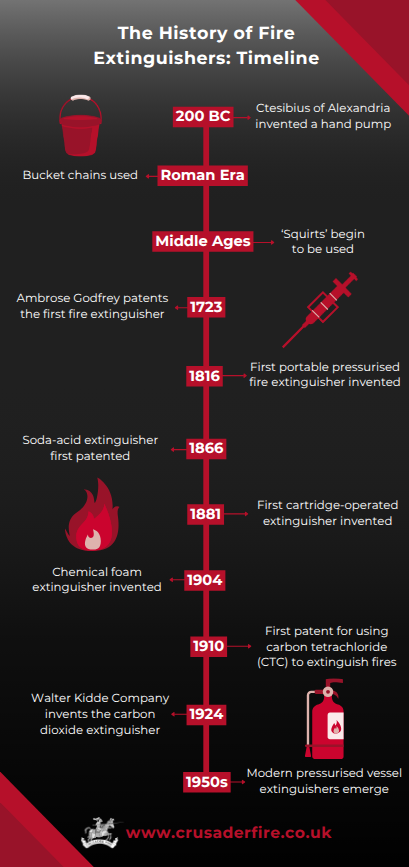
The History Of Fire Extinguishers infographic detailing the timeline below in a simple way, using the very dark grey and red of Crusader Fire’s styling.

BC to Post-Medieval

200 BC – Ctesibius of Alexandria invented a hand pump

The earliest records of fire suppression devices date back to 200 BC. Ancient Greek engineer and inventor, Ctesibius of Alexandria, created a hand pump to spray water onto fires. The device was similar to modern-day manual water pumps and worked more effectively than throwing buckets of water.

Romans – Bucket chains (buckets passed hand-to-hand in a line)

The Romans continued to use buckets to extinguish fires. The bucket chain method had multiple people in a line passing buckets of water from the water source to the fire. This was a crucial early fire response method to contain fires before they spread.

Middle Ages – ‘Squirts’ began to be used

In the Middle Ages, ‘squirts’ were developed. These looked like large syringes made of brass, holding water to be sprayed at the fire. The nozzle would be dipped into a bucket of water and the rod pulled out, which drew the water into the squirt for dispersal. They required two people to use it.

1666 – The Great Fire of London

The Great Fire of London started on Pudding Lane and burned for almost five days. Squirts were used during The Great Fire of London but, because they did not offer a continuous flow of water and required constant refilling of the 4.5 litres of water, they weren’t effective at containing the blaze.

18th-19th Century

1723 – The first fire extinguisher is patented

Ambrose Godfrey patented the first fire extinguisher in 1723. Godfrey was a chemist and created a fire extinguisher with a pewter chamber of gunpowder, which would scatter the fire-extinguishing liquid when ignited.

1816 – Portable pressurised fire extinguisher invented

George William Manby, a British Captain, invented the first portable pressurised fire extinguisher in 1816. This copper vessel contained a potassium carbonate solution (also known as pearl ash) contained in compressed air. Operating it would expel liquid onto the fire.

Who invented the fire extinguisher?

The question of who invented the fire extinguisher isn’t straightforward to answer. Godfrey patented the first fire extinguisher, but Manby evolved the concept into something much closer to modern-day fire extinguishers.

1866 – Soda-acid extinguisher first patented

Francois Carlier of France patented the soda-acid extinguisher in 1866. The extinguisher mixed a water and sodium bicarbonate solution with tartaric acid, which created carbon dioxide (CO2) gas to extinguish fires.

1881 – First cartridge-operated extinguisher invented

In 1881, Read & Campbell invented the cartridge-operated extinguisher. The internal cartridge containing compressed gas would release on activation and propel the extinguishing agent towards the fire.

20th-21st Century

1904 – Chemical foam extinguisher invented

Aleksandr Loran created the chemical foam extinguisher in 1904. The introduction of these extinguishers, smothering flames with foam instead of water, helped to smother liquid and oil fires and eventually led to the development of modern foam-based extinguishers.

1910 – First patent for using carbon tetrachloride (CTC) to extinguish fires

The Pyrene Manufacturing Company patented the use of carbon tetrachloride (CTC) in 1910 as a fire-extinguishing agent. While this proved to be an effective way to extinguish electrical fires, the use was later banned because of toxicity and harmful environmental effects.

1924 – First carbon dioxide extinguisher invented

The Walter Kidde Company introduced the first carbon dioxide (CO2) fire extinguisher in 1924. They remain some of the most common you’ll see in office buildings and server rooms. They displace the oxygen around the fire and suffocate it, effectively extinguishing the flames by starving it of the fuel it needs to burn.

Mid-20th Century – Modern extinguishers emerged

Despite the huge developments in fire extinguishing technology, it wasn’t until the mid-20th Century that we saw the creation of modern extinguishers as we know them today. These extinguishers used different extinguishing agents to effectively tackle fires, including water, foam, CO2, and dry chemicals.

Advancements in fire extinguisher technology

Fire protection, firefighting, and extinguishers have changed throughout the years, but there have been huge advancements recently, including:

  • The introduction of environmentally friendly extinguishing agents to replace harmful chemicals
  • Smart technology integrations to automatically detect and extinguish fires
  • More efficient materials to make extinguishers easier to use

Fire extinguisher installation and servicing from Crusader Fire

Improvements in regulations mean that extinguishers fit standard designs and are widely available in homes, businesses, and vehicles. These essential