
Fire extinguishers don’t have to be complicated. Crusader Fire’s UK fire extinguisher guide tells you everything you need to know about classes of fire, types of extinguishers, and current UK regulations. Read our guide or contact the team for support.
Fire Extinguisher Regulations in the UK
The Regulatory Reform (Fire Safety) Order 2005 (RRO) is the primary fire extinguisher regulation for the UK. It applies to businesses, public buildings, and landlords. These regulations cover the following:
- The minimum number of fire extinguishers required. A fire risk assessment will determine the correct number for your commercial premises.
- A fire risk assessment. Regular risk assessments are required for business owners and landlords. This ensures that fire protection measures are adequate.
- The location and accessibility of extinguishers. Fire extinguishers should be clearly visible and easily accessible. They must also be positioned near exits or areas of fire risk.
- The correct fire extinguishers for the risk. Fire extinguishers must be suitable for the fire risks present. Our guide helps you find the right type.
- Staff training in fire safety and the use of extinguishers. Basic fire safety procedures and how to use fire extinguishers is critical for employee training.
- Servicing and maintenance. BS 5306-3 states that a competent person must inspect and service fire extinguishers at least once a year in order to effectively maintain them.
Categories of Fire Extinguishers, Types of Fires and Your UK Fire Extinguisher Guide
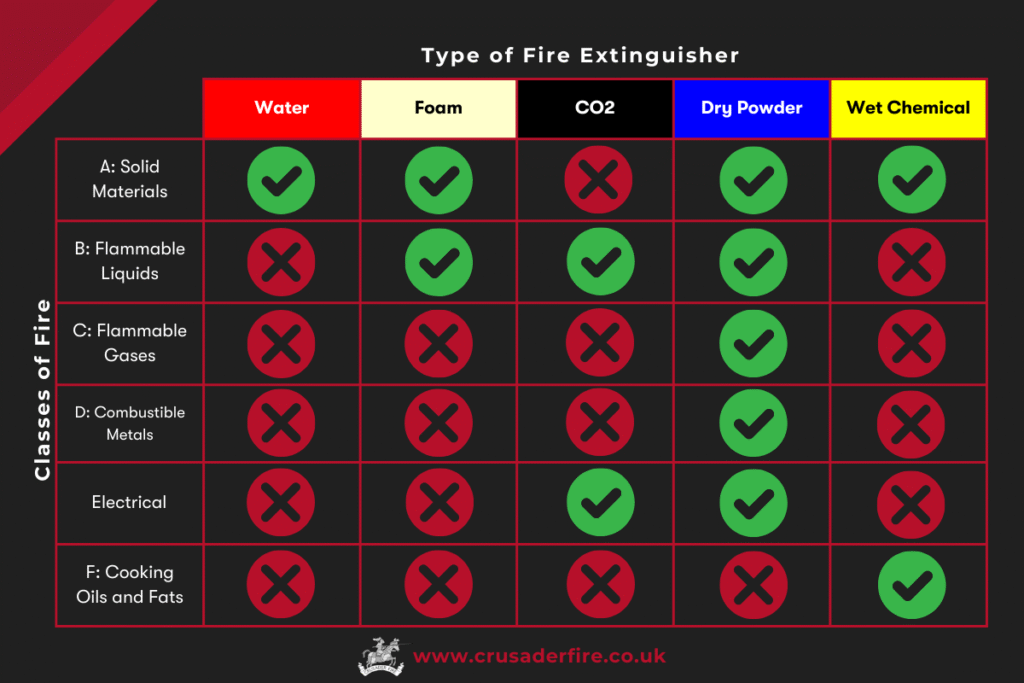
There are different fire extinguisher categories to deal with different classes of fires. For example, a foam extinguisher is unsuitable for cooking oil fires but works well against other flammable liquids. Discover the difference between fire extinguisher colours and fire classes.
Fire Extinguisher Types
Water Fire Extinguishers
Water extinguishers are the most common and inexpensive. Featuring the distinctive ‘signal red’ colour label, they can be found in the majority of buildings. They are best suited for solid combustibles. Experts recommend not using water fire extinguishers on liquid or electrical fires.
Foam Fire Extinguishers
Foam extinguishers are the second most common and feature a cream label. These water-based foam extinguishers are ideal on solid combustibles and flammable liquid fires, as they form a barrier to smother the fire and prevent potential reignition. They are not recommended for domestic use.
CO2 Fire Extinguishers
Carbon Dioxide extinguishers have a distinctive black label on them and are primarily used to deal with electrical fires. For this reason, they are commonly seen in office blocks and server rooms, and work vehicles must carry a 2kg CO2 extinguisher as standard. They are safe to use on both high and low electrical voltage.
Dry Powder Fire Extinguishers
The blue-labelled dry powder extinguishers, sometimes referred to as ABC fire extinguishers, are versatile in their use but not suitable for enclosed spaces. The powder is difficult to clean, can easily be inhaled, and can obscure vision. They can be safely used on electrical items up to 1000 volts.
Wet Chemical Fire Extinguishers
Wet chemical extinguishers are specialists featuring yellow labels. They are designed to treat fires involving cooking oils and fats by creating a soapy layer to prevent reignition and cool the fire, making them a common sight in commercial kitchens. They are designed for use on extremely high temperature fires.
Our fire safety training helps your team understand what to do in case of a fire. They’ll benefit from preparedness, risk reduction, and fire safety awareness to give you and your team complete peace of mind. Read some of the reviews on our training and schedule yours today.
Fire Classes and Using the Right Extinguisher
Fires are classified by the materials involved in the fire. Different fires require different extinguishers to prevent their spread and successfully extinguish the flames.
Class A: solid materials
Class A fires involving solid materials such as wood, paper, and textiles require one of the following extinguishers:
- Water fire extinguishers (red label)
- Foam fire extinguishers (cream label)
- Dry powder fire extinguishers (blue label)
- Wet chemical fire extinguishers (yellow label)
Class B: flammable liquids
Flammable liquids such as petrol, solvents, and most oils (not including cooking oils) are considered Class B fires. The best extinguishers for these fires are:
- Foam fire extinguishers (cream label)
- CO2 fire extinguishers (black label)
- Dry powder fire extinguishers (blue label)
Class C: flammable gases
Class C fires involve flammable gases such as propane and butane. These fires require a specialist extinguisher to effectively extinguish them.
- Dry powder fire extinguishers (blue label)
Class D: combustible metals
Combustible metals, like lithium and magnesium, are counted as Class D fires. They als require a specialist extinguisher to deal with:
- Dry powder fire extinguishers (blue label)
Electrical fires
Electrical fires are in a class of their own. They need a specialist fire extinguisher to prevent the spread of fire, extinguish the flames, and reduce the risk of electrocution.
- CO2 fire extinguishers (black label)
- Dry powder fire extinguishers (blue label)
Class F: cooking oil and fat
Class F fires involve cooking oils and fats. The way that these fires burn means that they cannot be tackled with traditional extinguishers used for flammable liquids. For those, you have to use a specialist extinguisher:
- Wet chemical fire extinguishers (yellow label)
Unsure about which fire extinguisher to use? Our handy guide below should help, telling you the different fire extinguisher colours, fire classes, and when to use them.
Is Your Business Equipped to Handle Fires?
Fire safety training and the correct use of fire extinguishers should be essential in every business. Failure to follow UK fire regulations and incorrect training can be hazardous, which is where Crusader Fire comes in.
Our tailored training can help your team with:
- Fire safety awareness
- Fire warden training
- Fire extinguisher training
The training programs are run by expert instructors at your place of work. Don’t take chances when it comes to fire safety – get a free quote for training today.